


By Bharat 0 km Desk| 9 September 2026| Life Science|
THE DAY THE DINOSAURS DIED: HOW ONE ASTEROID CHANGED LIFE ON EARTH FOREVER
Dinosaurs Extinction | bharat0km Chronicles
⭐For more than 170 million years, dinosaurs dominated the planet. Then, in a matter of hours, Earth entered one of the darkest chapters in its history. What killed the dinosaurs—and why did some animals survive while others disappeared forever?
There was a time when Earth belonged to dinosaurs.
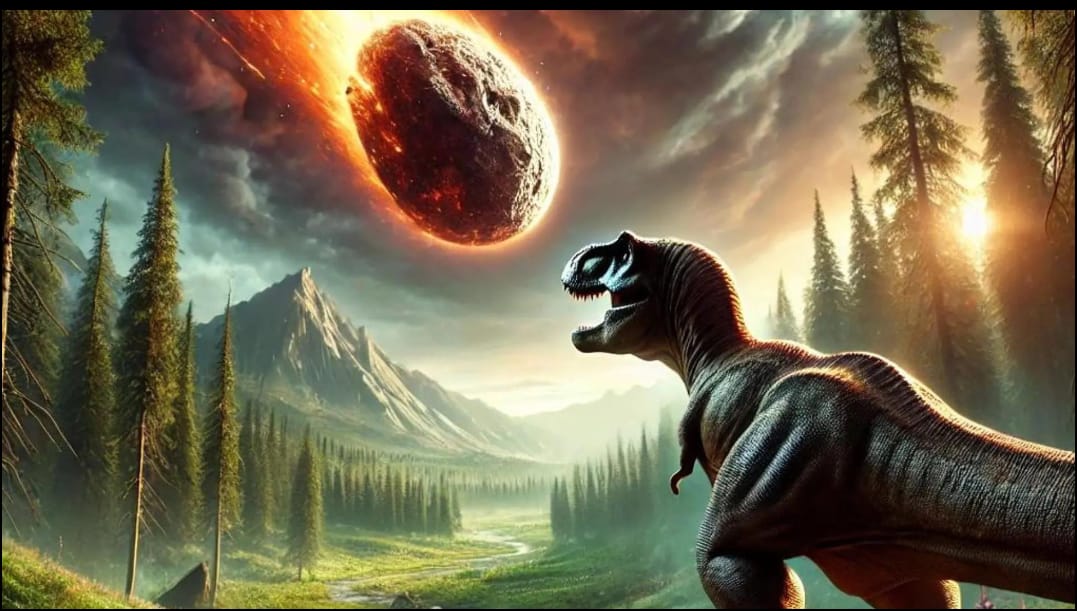

⭐Long before humans appeared, these extraordinary animals occupied almost every major terrestrial ecosystem on the planet. Some were enormous herbivores weighing tens of tonnes, while others were fast-moving predators. During the Cretaceous Period, dinosaurs reached an extraordinary level of diversity, from giant plant-eaters and heavily armoured species to terrifying predators such as Tyrannosaurus rex. The fossil record shows that dinosaurs had already survived dramatic changes in climate and geography over hundreds of millions of years,But approximately 66 million years ago, their reign came to a catastrophic end.
✍️And surprisingly, the story of their extinction is not simply the story of a giant rock hitting Earth.
📖It is the story of fire, darkness, collapsing food chains, freezing temperatures, acid rain, atmospheric changes and a planet suddenly transformed into an environment in which most large land animals could no longer survive.
🌟WHERE DID DINOSAURS COME FROM?
The story begins much earlier.
✨Scientists estimate that the first dinosaurs appeared roughly 230–240 million years ago, during the Triassic Period. The oldest dinosaur fossils currently known date to around 231.4 million years ago.
Earth looked dramatically different at that time.

👉The continents we know today were joined together into one enormous supercontinent called Pangaea. The climate was generally dry and arid, and dinosaurs were initially relatively small compared with the giants that would evolve later.
👉One early dinosaur, Eoraptor, is considered among the earliest known dinosaurs and provides an important glimpse into the beginnings of this extraordinary group.
But dinosaurs did not immediately become Earth’s rulers.
At first, they lived alongside many other reptiles and animals. Then Earth itself began changing.
👉Around 201 million years ago, the Triassic Period ended following major environmental upheaval. Pangaea began breaking apart, enormous volcanic activity occurred, and huge quantities of gases entered the atmosphere.
👉Carbon dioxide contributed to warming, while sulphur dioxide and atmospheric aerosols affected sunlight and climate. Ocean chemistry also changed.
Many animals struggled to cope with these rapidly changing conditions.
🦕Dinosaurs, however, survived.
That survival became one of the turning points in Earth’s history.
🌟FROM SMALL ANIMALS TO PLANETARY GIANTS
✍️The next chapter was the Jurassic Period, lasting roughly from 201 to 145 million years ago.
👉During this period, dinosaurs expanded dramatically in size and diversity. Some giant herbivores reached enormous dimensions, while other dinosaur groups developed completely different adaptations.
✍️Some even evolved feathers and eventually flight. Archaeopteryx, for example, represents an important early feathered dinosaur.
⭐Meanwhile, Pangaea continued breaking apart into major landmasses that eventually developed into the continents we recognise today.
✍️But dinosaurs reached perhaps their greatest diversity during the Cretaceous Period, which began around 145 million years ago and ended about 66 million years ago.
👉This was the age of T. rex, Triceratops, raptors, giant titanosaurs and numerous other dinosaur groups.
👉Some giants could weigh many tonnes. Some dinosaurs were extremely fast, while others evolved armour, horns or other specialised features.
👉Even the skies contained enormous flying reptiles such as Quetzalcoatlus, whose wingspan may have reached around 10–11 metres.
🌎The planet was warm, sea levels were high, flowering plants had evolved, and dinosaurs occupied an enormous range of ecological niches.
From the outside, their future looked secure.But beneath that apparently stable world, something much bigger was coming.

🌟WHAT DID DINOSAURS NEED TO SURVIVE?To understand why dinosaurs died, we first need to understand what any large animal requires to survive.
🦕A dinosaur needed:
•Food and functioning food chains
•Water
•Suitable temperatures
•Habitable land
•Plants for herbivores
•Other animals for carnivores
•Enough sunlight to sustain ecosystems
•Places to reproduce and raise offspring
📖A giant herbivore could survive only if enough vegetation existed.
A large predator depended on those herbivores—or other animals—being available.
🦕In other words, dinosaurs were not independent from the environment.
👉They were part of an enormous biological network.
🪨And the asteroid didn’t simply kill individual dinosaurs.
•It attacked the system that kept them alive.
📖THE ASTEROID THAT CHANGED EVERYTHING
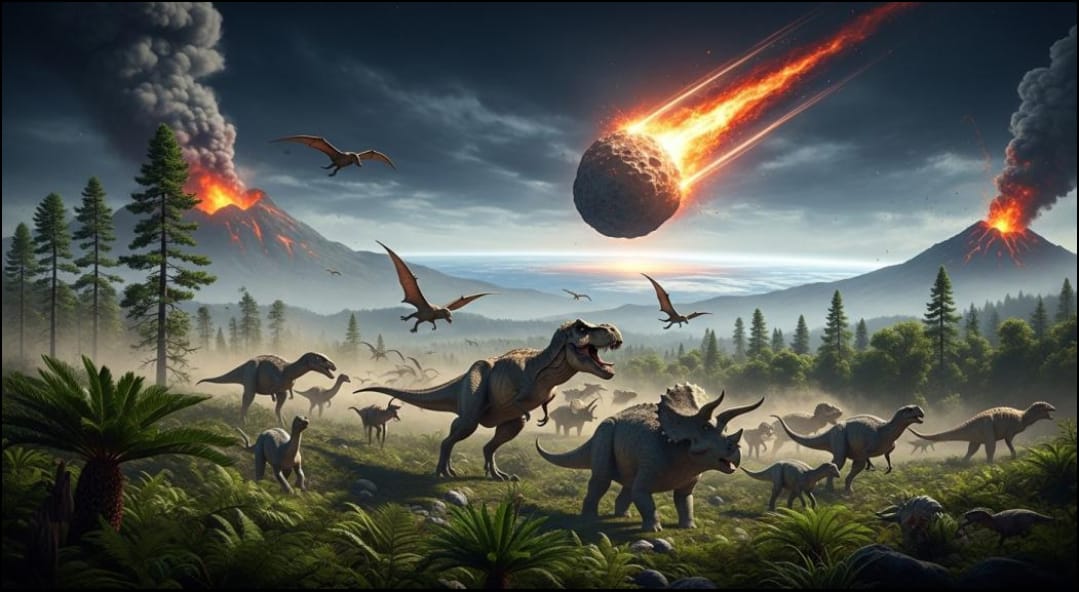
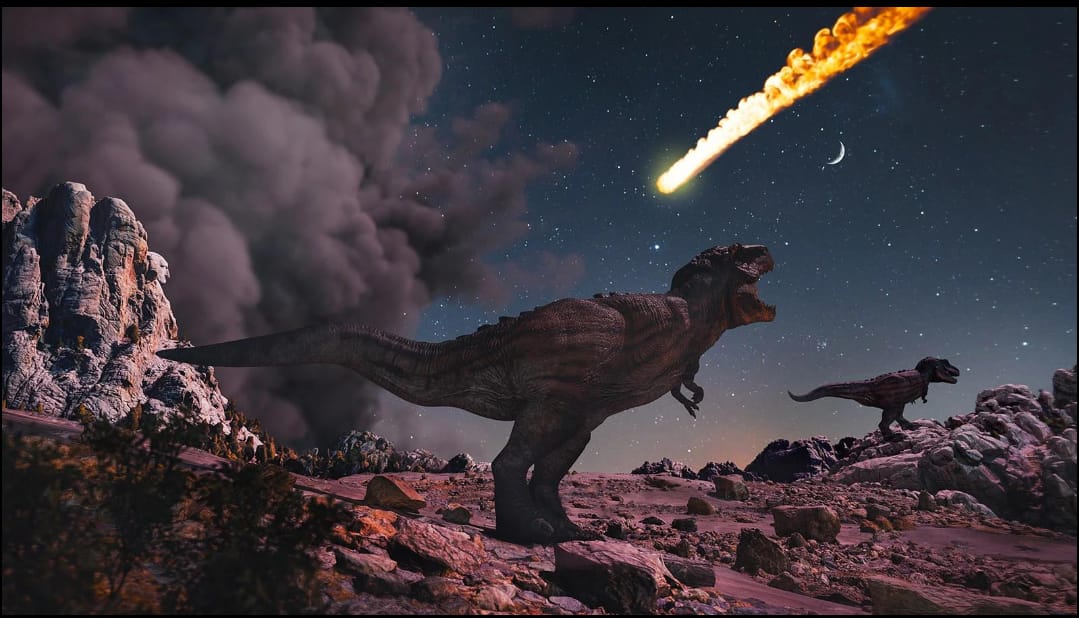
👉Approximately 66 million years ago, an asteroid estimated to be roughly 10–15 kilometres across came toward Earth.
👉It struck the Yucatán Peninsula in present-day Mexico at an enormous velocity—around 30 kilometres per second according to the source material.
👉The impact created the enormous Chicxulub crater, approximately 180 kilometres across.
✍️The energy released was beyond anything humans had ever experienced.
✍️The impact instantly transformed the surrounding region.
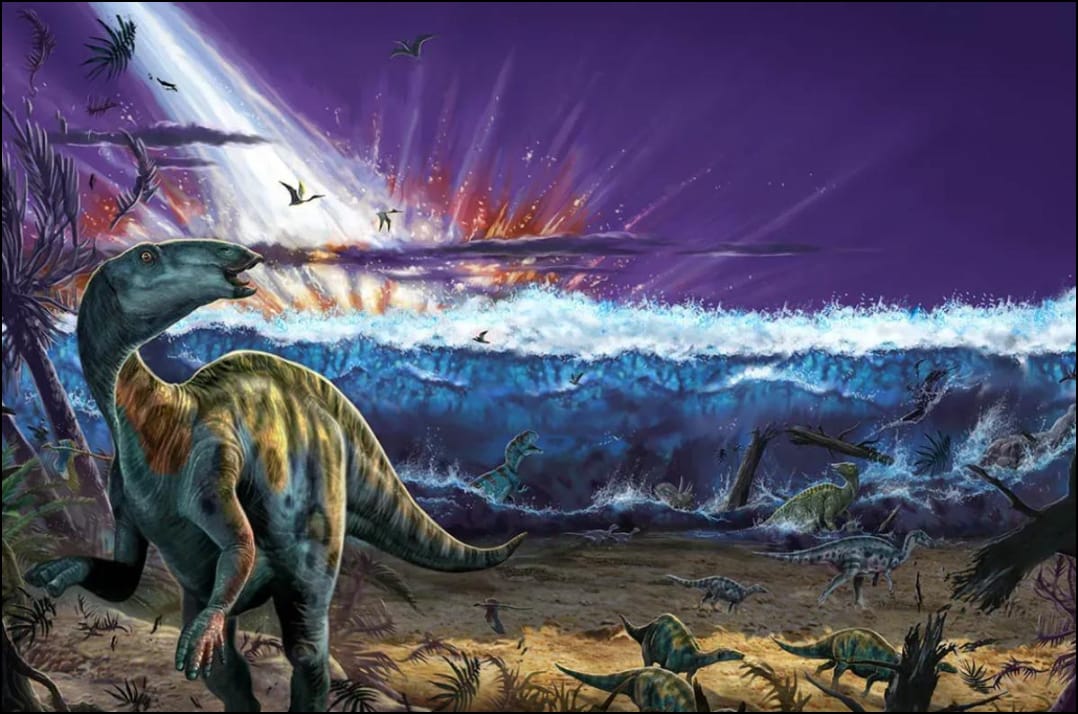
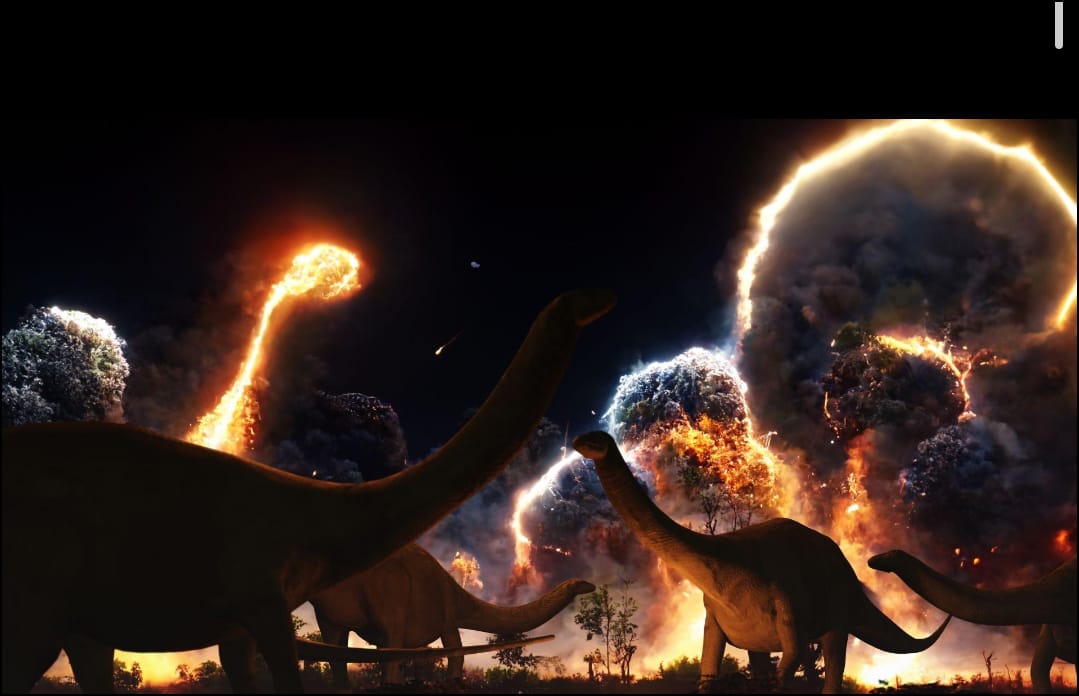
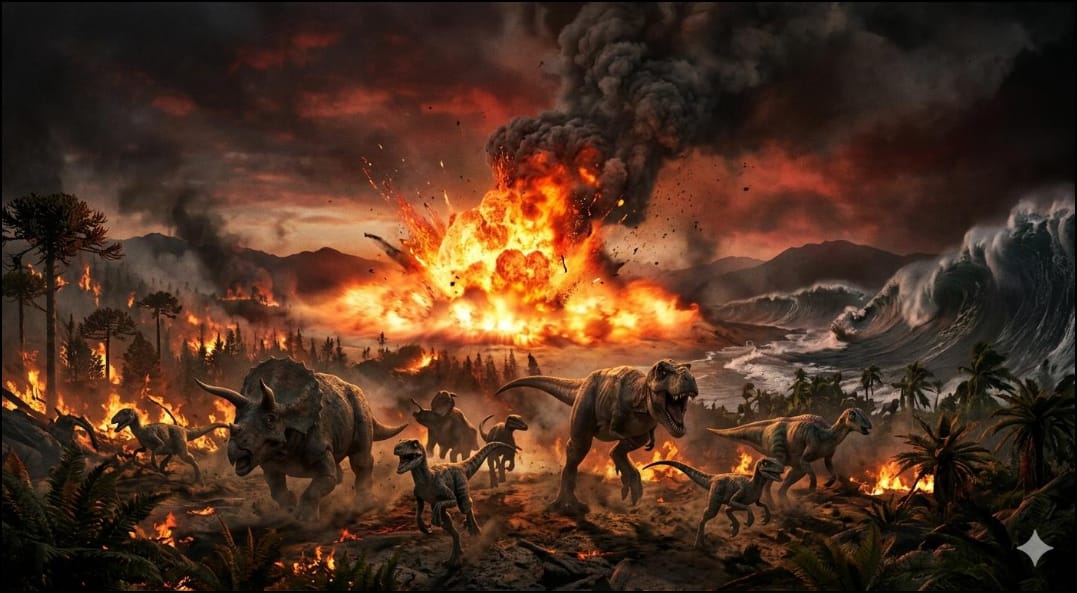
👉Rock and soil were blasted into the atmosphere. Enormous shock waves travelled across the planet. Extreme heat triggered widespread wildfires, and gigantic tsunamis swept across coastlines.
The immediate destruction was horrifying.
👉Animals living thousands of kilometres from the impact zone could still have been affected by heat pulses, fires and atmospheric debris.
But that was only the beginning.
✍️The asteroid’s most important weapon was not the crater. It was what it put into the atmosphere.
🌟EARTH ENTERED A PERIOD OF DARKNESS
•The impact threw enormous quantities of dust and other material high into the atmosphere.
📖There was another crucial factor.
•The rocks at the impact site contained substantial amounts of sulphur and carbon-bearing material. The collision released these materials into the atmosphere, contributing to major environmental disruption.
•Dust and atmospheric particles reduced the amount of sunlight reaching Earth’s surface.
•For a planet whose ecosystems depended on sunlight, this was devastating.
•Plants require sunlight for photosynthesis.
•When sunlight was dramatically reduced, photosynthesis collapsed.
•Plants began dying and that triggered the next disaster.

🌟THE FOOD CHAIN COLLAPSED
👉Imagine the food chain as a giant pyramid.
At the bottom are plants>Above them are herbivores>Above herbivores are carnivores.
💭Remove the bottom—and eventually the entire structure begins collapsing.
That is essentially what happened.
•Plants died because sunlight was severely reduced.
•Herbivorous dinosaurs then faced an enormous shortage of food.
•When herbivores disappeared, carnivorous dinosaurs lost their primary food sources.
•So even predators that had survived the initial blast could not escape the consequences.
📖This is why it is misleading to say:
“The asteroid killed the dinosaurs.”
👉The asteroid triggered the catastrophe.
👉The collapse of Earth’s ecosystems completed the extinction.
🌟WHY DIDN’T DINOSAURS JUST MOVE SOMEWHERE ELSE?
This is one of the most important questions.
🌎After all, the asteroid hit Mexico—not every part of Earth.
📖So why couldn’t dinosaurs simply migrate?
👉Because the disaster was global.
•The atmospheric dust and gases were distributed around the planet. Sunlight was reduced far beyond the impact zone. Temperatures fell dramatically, and the disruption to ecosystems extended across continents.
•The source material describes a period in which Earth experienced a severe “nuclear winter”-like climate.
•For large animals, this was catastrophic.
•A 10-tonne herbivore cannot simply survive by hiding underground for months.
•It requires enormous amounts of food.
•And once the vegetation disappeared, size itself became a disadvantage.
•The larger the animal, the more energy it generally needs.
•That helps explain why the extinction disproportionately destroyed large terrestrial animals.
🌟SO HOW DID SOME ANIMALS SURVIVE?
👉This is perhaps the most fascinating part of the story.
•The asteroid did not kill everything.
•Some animals had characteristics that gave them a much better chance of surviving a world where sunlight, vegetation and temperature had suddenly become unreliable.
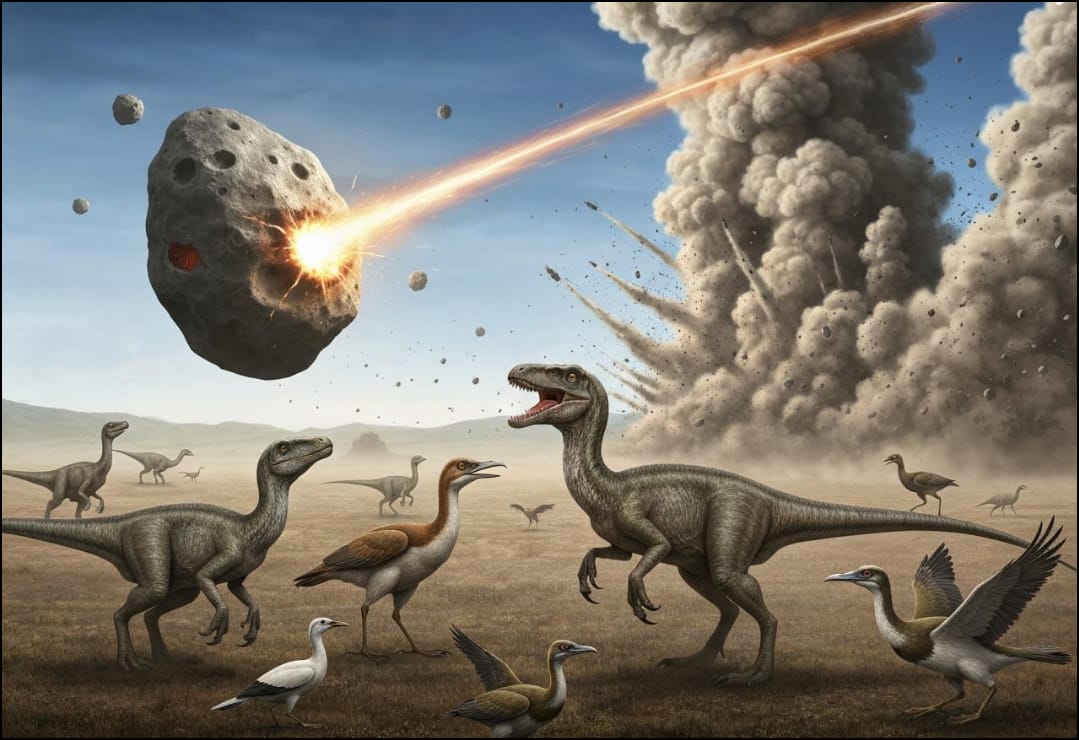
✍️According to the scientists, survivors included small mammals, lizards, turtles and some birds, along with crocodilians.
🗣️What did they have in common?
•Many were relatively small.
•Some could shelter underground, inside caves, underwater or in protected environments.
•And critically, several could survive on a much broader range of food.
•When normal food chains collapsed, small omnivorous animals could consume things such as carrion, decaying organic matter, insects, seeds or whatever limited resources remained available.
•This was an enormous survival advantage.

🌟WHY SIZE BECAME A DISADVANTAGE
💭Think about a huge herbivorous dinosaur.
•It may require an enormous amount of vegetation every day.
•Now imagine the Sun disappearing behind atmospheric dust.
•Plants stop growing.
•The giant herbivore has no food.
👉A small animal, however, requires much less energy.
•It can hide.
•It can eat smaller food sources.
•It may survive on seeds, insects, carrion or decomposing material.
•This created a brutal evolutionary filter.
✍️The extinction was not necessarily about which animal was strongest. It was about which animal could survive the new environment.
✍️The biggest and most specialised animals often had the least flexibility.
👉Smaller, more adaptable creatures had a better chance.
🌟AND WHAT ABOUT CROCODILES?
👉Crocodilians are one of the most remarkable survivors of this catastrophe.
✍️They are ectothermic, meaning their body temperature depends heavily on the surrounding environment. Their metabolism can therefore be much slower than that of mammals and birds, particularly under cold conditions.
👉That gives them an important survival advantage during periods of food scarcity.
✍️A crocodilian does not need to eat as frequently as a large warm-blooded animal.
👉Aquatic habitats also offered protection from some of the extreme conditions occurring on land.
✍️Rivers, lakes and wetlands could provide shelter and access to food even while terrestrial ecosystems were collapsing.
👉But it is important to understand that crocodilians did not survive simply because they were “cold-blooded.”
✍️Their survival was likely the result of a combination of factors—their physiology, aquatic lifestyle, relatively low energy requirements and ability to endure long periods of limited food.
🌟THE BIGGEST SURVIVORS WERE NOT THE BIGGEST DINOSAURS
•Here comes one of the most extraordinary twists.
Dinosaurs did not completely disappear.
🐦Birds survived.
👉Modern birds are living descendants of the dinosaur lineage. In evolutionary terms, the dinosaurs did not vanish entirely; one branch survived and eventually produced the enormous diversity of birds we see today.
📖So technically, when you see a chicken, sparrow, eagle or ostrich, you are looking at a living representative of a dinosaur lineage.
👉The terrifying world of T. rex eventually gave rise to a world in which dinosaurs became small, feathered and airborne.
That is one of evolution’s greatest stories.
🌟HOW DO WE KNOW AN ASTEROID ACTUALLY CAUSED THE EXTINCTION?
•This isn’t simply a theory based on fossils.
📖Scientists found a remarkable geological clue.
⭐Iridium.
👉Iridium is extremely rare in Earth’s surface rocks but is comparatively abundant in many extraterrestrial objects such as asteroids.
📖Scientists discovered an unusual global layer enriched in iridium associated with the boundary between the Cretaceous and the following geological period.
👉Dating this layer places it at approximately 66 million years ago.
👉The evidence strongly connects this global iridium-rich layer with the asteroid impact.
✍️Then came the discovery of the enormous impact structure beneath the Yucatán region.
💭The crater is partly beneath land and partly beneath the Gulf of Mexico.
✍️Together, the geological evidence, the crater and the biological record provide an extraordinary picture of what happened.
🌟MORE THAN 75% OF LIFE DISAPPEARED
👉The asteroid impact is associated with one of Earth’s great mass extinctions.
👉More than 75% of species are estimated to have disappeared around this event.
🦕The dinosaurs were among the most visible victims, but they were far from the only ones.
🌊Marine ecosystems were heavily affected.
🌵Plants suffered.
🦎Numerous reptiles and other animals disappeared.
•Entire ecological relationships collapsed.
•Earth’s biological landscape was fundamentally rewritten.
•But extinction created something else:

👉OPPORTUNITY
🌟THE END OF THE DINOSAURS OPENED THE DOOR FOR MAMMALS
✍️For more than 170 million years, dinosaurs had occupied many of the dominant terrestrial ecological roles.
✍️Once the non-avian dinosaurs disappeared, enormous ecological spaces suddenly became available.
•Mammals diversified into many of these empty niches.
∆Over millions of years, mammals evolved into forms that eventually included:
•horses, whales, bats, primates and many other groups.
•Smaller reptiles and snakes also diversified.
•And much later, one particular mammalian lineage would produce something that had never existed before HUMANS
👉Our existence is therefore indirectly connected to one of the greatest catastrophes in Earth’s history.
✍️Had the asteroid never struck, the evolutionary history of mammals—and consequently our own—might have been radically different.
📖THE REAL LESSON OF THE DINOSAUR EXTINCTION
👉The extinction of the dinosaurs teaches us something bigger than the danger of asteroids.
✍️It shows how interconnected life is.
An ecosystem can appear stable for millions of years.
•Then one event changes the atmosphere.
•The atmosphere changes the climate.
•The climate changes plant growth.
•Plant loss affects herbivores.
•Herbivore loss affects predators.
•And suddenly an entire biological network collapses.
•The dinosaurs did not become extinct because they were weak.
•They became extinct because Earth changed faster and more dramatically than most of them could adapt.
📖COULD THE SAME THING HAPPEN TO HUMANS?
•Asteroids continue to pass through the Solar System, and scientists constantly monitor potentially hazardous near-Earth objects.
•Modern astronomy can track many asteroids, calculate their trajectories and estimate the probability of an impact.
•Humanity has even begun testing ways to alter an asteroid’s path.
•NASA’s DART (Double Asteroid Redirection Test) mission demonstrated that a spacecraft could deliberately collide with an asteroid and change its motion.
•That does not mean humanity is completely safe.
•But unlike the dinosaurs, we possess something they never had:
•the ability to see the threat coming and attempt to do something about it.
📖THE SIXTH EXTINCTION: THIS TIME, THE CAUSE IS DIFFERENT
✍️There is another uncomfortable comparison.
👉The dinosaur extinction was caused by a natural cosmic catastrophe.
💭Today’s biodiversity crisis is different.
•Human activities—including habitat destruction, pollution and other pressures—are driving species loss at an unusually high rate.
•The transcript describes this as part of what scientists call the Holocene Extinction and highlights the rapid loss of biodiversity over the last centuries.
•That makes the dinosaur story more than an ancient tale.
🚨It is a warning.
👉The dinosaurs had no way to stop the asteroid.
👉We do have the ability to influence our own future.
🌟THE LAST QUESTION
👉Dinosaurs ruled Earth for roughly 174 million years.
👉Modern humans have existed for only around 300,000 years.
🔢Put those numbers side by side and the difference is staggering.
🦕The dinosaurs had hundreds of millions of years of evolutionary history behind them.
👉Humans have had only a tiny fraction of that time.
✍️Yet we have developed the ability to reshape the planet, alter ecosystems, change the atmosphere and even potentially defend ourselves against threats from space.
📖The question is no longer simply:
•“How did the dinosaurs die?”
👉The more important question may be:
🌟What will humanity do with the opportunity that their extinction gave us?
👉One asteroid ended the age of the non-avian dinosaurs.
👉It also opened the door to the age of mammals—and eventually to us.
👉The next chapter of Earth’s story, however, is being written by humans.
👉And unlike the dinosaurs, we know that extinction is possible.
✍️The real challenge is making sure that humanity doesn’t become the next species remembered only through fossils.

Bharat0km desk | Post credit Bajrangi.